|
500 years of carving music from the forest...
The trade of violin making has entered a new golden age! The Violin Shoppe is committed to providing modern musicians with world-class
violins, violas, cellos, basses, and bows from modern makers.
Please look through our instrument listings to read descriptions
of works by modern makers.
|
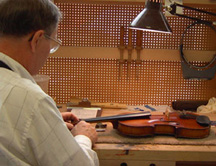 1. The maker develops the design, or model of the instrument.
When we build string instruments, we are actually
building a unique voice, whose tone and characteristics
must be chosen before designing the instrument. For
instruments made on commission, the design will be
made only after much consultation with the musician,
and the instrument will be tailored to meet the musician's
unique needs and tastes. Often, some variant of a
Stradivari or Guarneri design is used, as these are
some of the finest designs ever developed.
1. The maker develops the design, or model of the instrument.
When we build string instruments, we are actually
building a unique voice, whose tone and characteristics
must be chosen before designing the instrument. For
instruments made on commission, the design will be
made only after much consultation with the musician,
and the instrument will be tailored to meet the musician's
unique needs and tastes. Often, some variant of a
Stradivari or Guarneri design is used, as these are
some of the finest designs ever developed.
2. The mold is fabricated. This is a frame around
which the instrument is made. The sides of the mold
are cut to precisely match the inside dimensions of
the instrument body.
3. Blocks of spruce are fashioned and glued to the
mold. These four corner blocks and two end blocks
form the basic skeleton of the instrument. A weak
glue is used, to allow the blocks to break free from
the mold at a later stage.
4. The ribs, or sides are bent using a very hot bending
iron to match the shape of the mold, These are usually
made of a type of maple. The rib stock is bent dry,
although some makers use a little water to prevent
scalding. Wood, after being heated and bent, will
hold its shape. This is virtually the same principle
that has allowed aboriginal peoples the world over
to straighten arrow shafts and spears, and is also
used in the process of bending bows, although such
bending is often done over a flame, rather than on
an iron. The ribs, after bending are glued to the
blocks. Hide glue is used throughout the process.
Hide glue is made from a membrane inside the skin
of animals which is removed during the tanning process.
Raw hide still has the hide glues present, causing
it to feel rather sticky when moistened. This is still
the finest glue available for string instruments because
it has the perfect combination of hardness, adhesion,
acoustic properties, appearance, and failure modes.
5. Linings are made of willow or spruce and are bent
on the iron and glued to the inside of the ribs, on
the side which will join the back. Some makers make
linings for the top edge at this step, but they cannot
be glued in yet. Linings add strength to the instrument,
and add rigidity to the edges which is important for
acoustic reasons.
6. The back is usually made of maple. A one-piece
or two-piece back may be used. A two-piece back is
made by splitting a wedge of wood in half, then opening
up the split piece like a book so that perfect symmetry
is achieved. The pieces are planed flat on the edge
and joined with glue. This process is called book-matching.
7. Using a series of templates, the outside of the
back is carved to the proper arch, and the outline
is cut to match the ribs. The carving of the back
is one of the most time-consuming stages of instrument
building. After the outside is nearly finished, the
inside of the back will be carved out to the exact
specifications required to achieve the desired voice.
8. The back is glued to the ribs and blocks after
most of the carving is complete. Then a channel is
carved along the edge of the violin to accommodate
an inlay known as purfling. These small three strips
of wood will not only add beauty to the instrument,
but will help to prevent cracks from propagating from
the edges into the centers of the back and top. After
the purfling is in place, some final carving will
be done to give a flared edge all around the back,
making the instrument comfortable to hold and further
helping its voice. Once the back is on, the mold is
removed from the instrument and the top edge linings
are glued in place.
9. The top is made of spruce using much the same methods
as the back. After carving and purfling are complete,
the "f" holes are laid out using templates
and graphical formulae. They are cut out with knives,
and their design is critical to many aspects of the
violin's tone and response.
10. The last major step for the top, is to install
the bass bar, a long brace that runs most of the length
of the top along the bass side, under the bridge foot.
This is laid out according to a very precise formula.
The placement and design of the bass bar has a major
impact on the tone and response of the finished instrument.
After the bar is in place, the top is installed.
11. The neck and scroll are carved from a single sold
maple block, using special templates and tools. The
size of the scroll is important, as it affects the
way the instrument balances and feels in the player's
hands. The standard design of the scroll uses part
of the Ionic volute for its turns, which becomes the
Spiral of Archimedes when drawn in two dimensions.
About half way around the back of the scroll, the
spiral begins to approximate the Spiral of Vignola
before gracefully running out into the back of the
peg box. The scroll often shows much of the maker's
own style. Occasionally, the scroll is carved to resemble
the head of a person or animal.
12. The nearly finished neck is mortised into the
body of the instrument. The fingerboard is installed
temporarily to help center the neck. Once the neck
is in place and the back button has been trimmed,
the fingerboard is removed, and the instrument is
given a final scraping to prepare the wood surface
for varnish.
13. The varnishing process varies greatly among different
makers, but the general approach is similar. In general,
there are four stages: 1. wood preparation; 2. ground
varnish; 3. color varnish; 4. final polishing. Some
makers add a light stain to the wood, which can be
done by simply aging the violin in direct sunlight,
or by use of chemicals such as ammonia fumes. Some
makers instead use various types of light dyes or
stains applied directly to the wood. After the wood
has reached the desired color, some makers apply a
type of ground coat, which seals the wood and adds
color. Other makers do not use a true ground coat,
but instead begin applying clear varnish directly
to the wood. After one or more clear coats have been
applied, some varnish bearing color is applied. Finally,
the competed varnish is polished using either pumice
and oil, or a French polish technique where a very
light coat of varnish is applied with a rag, and a
little rottenstone is added to polish the varnish
at the same time as new varnish is being applied.
Varnish is usually either an oil varnish (combination
of a resin and an oil combined under heat) or a spirit
varnish (resin dissolved in alcohol.) Varnish making
is a complex topic and will not be discussed here.
There are many types of fine varnish available, so
the makers who make their own varnish do so because
they want to, not because they must. Varnish helps
protect the wood, adds beauty to the instrument, and
has a positive influence on the instrument's voice
and resonance.
14. After the varnish is compete, the fingerboard
is fitted to the neck, and final neck carving is done.
The neck wood may be lightly sealed with a drying
oil, but it is never varnished as this would slow
down the player's shifts. Then the peg holes and endpin
hole are drilled and reamed, and the pegs and endpin
are fitted.
15. The final stage is the one that, perhaps, takes
the most expertise of all: setting up. The fingerboard
must be dressed to be smooth and of the correct contour,
and the nut is installed and the string grooves made.
The bridge is fit to match the top and fingerboard.
Every cut of the bridge has an impact on the instrument's
playability and tone. Finally, the soundpost is installed
through the "f" hole. Once the soundpost
is in the correct location, the instrument is tuned
up and final soundpost adjustment is made. First the
location is measured again, and any needed corrections
made. Secondly, the post is inspected with mirrors
to be sure that it is making good contact with the
top of the instrument. Finally, the instrument is
tried out with a bow, and if any problems with its
response or playability are present, the post is adjusted.
This is not done by guesswork, but by a well-defined
process. Certain problems, such as sluggish spiccato,
a whistling string, or strings that feel too tight,
have certain solutions in the soundpost adjustment
process.
16. After the instrument is fully adjusted, it will
go through a break-in period of about a year or two.
During this time, the back stretches a little due
to soundpost pressure, and the maker or dealer may
need to install a longer soundpost if response suffers.
The instrument should develop a more open and resonant
sound as it is played in.
17. The final step for many makers, is to install
the label through the "f" hole, to show
all the world who created this beautiful instrument.
INSTRUMENTS FROM THE FOLLOWING MAKERS ARE OFTEN AVAILABLE
FROM THE VIOLIN SHOPPE!
(Makers are listed alphabetically.)
Douglas Cox ; Vermont; violins
Daniel Foster, Blacksburg, VA; viola
Mark Hough; Clinton, CT; violins
Thomas Hoyer; Germany; violins, violas, cellos
John Larrimore, Richmond, VA; violins, violas
Alfred Michels, Creston, NC; violins, violas, cellos,
basses, bows
Rebecca Mihalik; Glasgow, VA; violins, violas
Daniel Smith ; Lexington, VA;
violins
John Sipe, Charlotte, NC; violins, violas, cellos
Michael Vann , Vancouver, BC; bows
William Whedbee, Chicago, IL; viola, cello
OTHER NORTH CAROLINA VIOLIN MAKERS
Please contact
these makers directly.
Charles Nelson, shop of John Montgomery, Raleigh,
NC; violins
John Montgomery , Raleigh, NC; violins, violas
Kurt Widenhouse, Belmont, NC; violins, violas
Note: Some violin experts only restore, repair, and
sell violins. They may be listed on our page of Links
. Only active makers are shown here.
Please see our links page for more information on
makers. If you know of someone we left off our list,
please tell us!
|
|
| |
